
Tango Pools Journal
How to Evaluate Luxury Pool Builders in Michigan Before Design Begins
A pool builder’s portfolio can tell you whether you like the finished work. It cannot, by itself, tell you how that team will make decisions about your property. Before choosing among luxury pool builders in Michigan, look at the connection between the photographs, the planning process, and the scope you are actually considering.
For a custom pool, the comparison extends beyond the water. Patio space, views from the house, access for construction, an attached spa, and future outdoor features all influence the result. A useful first conversation makes those relationships easier to understand. This guide explains what to ask, what to bring, and how to compare answers without expecting a final design at the introductory meeting.
Start with a short brief about how you want to live outside
Give each prospective builder the same starting information. Otherwise, one may imagine a pool for quiet evening use while another prices a larger entertaining space. Both responses could be reasonable, but they would not be comparable.
Write down your three most important uses for the yard. These might be swimming, hosting family meals, and enjoying the view from the kitchen. Then separate essential features from optional ideas. If an attached spa is essential but a pavilion could come later, say that clearly. Describe what you want to preserve, too: a useful lawn, a favorite tree, or a view you do not want a new structure to block.
Bring photographs taken from the house as well as from the yard. A builder who asks about door locations, the route to a bathroom, and where guests will gather is exploring how the pool will work as part of the property. That is a more useful discussion than choosing a shape before anyone understands your priorities.
Ask how the property will influence the design
A pool that looks right in an inspiration photograph may need a different arrangement on your lot. Ask what the team needs to learn about grade, construction access, drainage, existing improvements, and available space before recommending a layout. You do not need to diagnose these conditions yourself. You do need to understand who will investigate them and when their findings will affect the plan.
Try a specific question: “If the pool moves closer to the house, what else would you need to reconsider?” A thoughtful discussion might cover patio depth, views from interior rooms, the route around the water, and the relationship to a future spa or outdoor kitchen. The goal is not an instant engineering answer; it is evidence that the design process considers consequences beyond the pool’s outline.
Tango Pools is based in Rochester and presents luxury pool design and construction as part of a coordinated outdoor environment. When discussing a Southeast Michigan property, bring the exact municipality and any existing survey or site plan. Ask the team to identify what additional information is needed rather than assuming neighboring communities have identical requirements.
Use the portfolio to ask better questions
Choose two or three projects that resemble the decisions you face, even if their overall style differs from yours. A pool on a sloping property may be more relevant than a visually similar pool on a flat, open lot. Likewise, a project with a close connection between the house, spa, and patio may be useful if outdoor circulation is your main concern.
For each example, ask which condition most influenced the design. Was the pool positioned to preserve a view? Did a grade change shape the terrace? Was the spa intended as a focal point from inside? If the team did not perform a particular part of the photographed project, ask it to distinguish its work from that of other contributors.
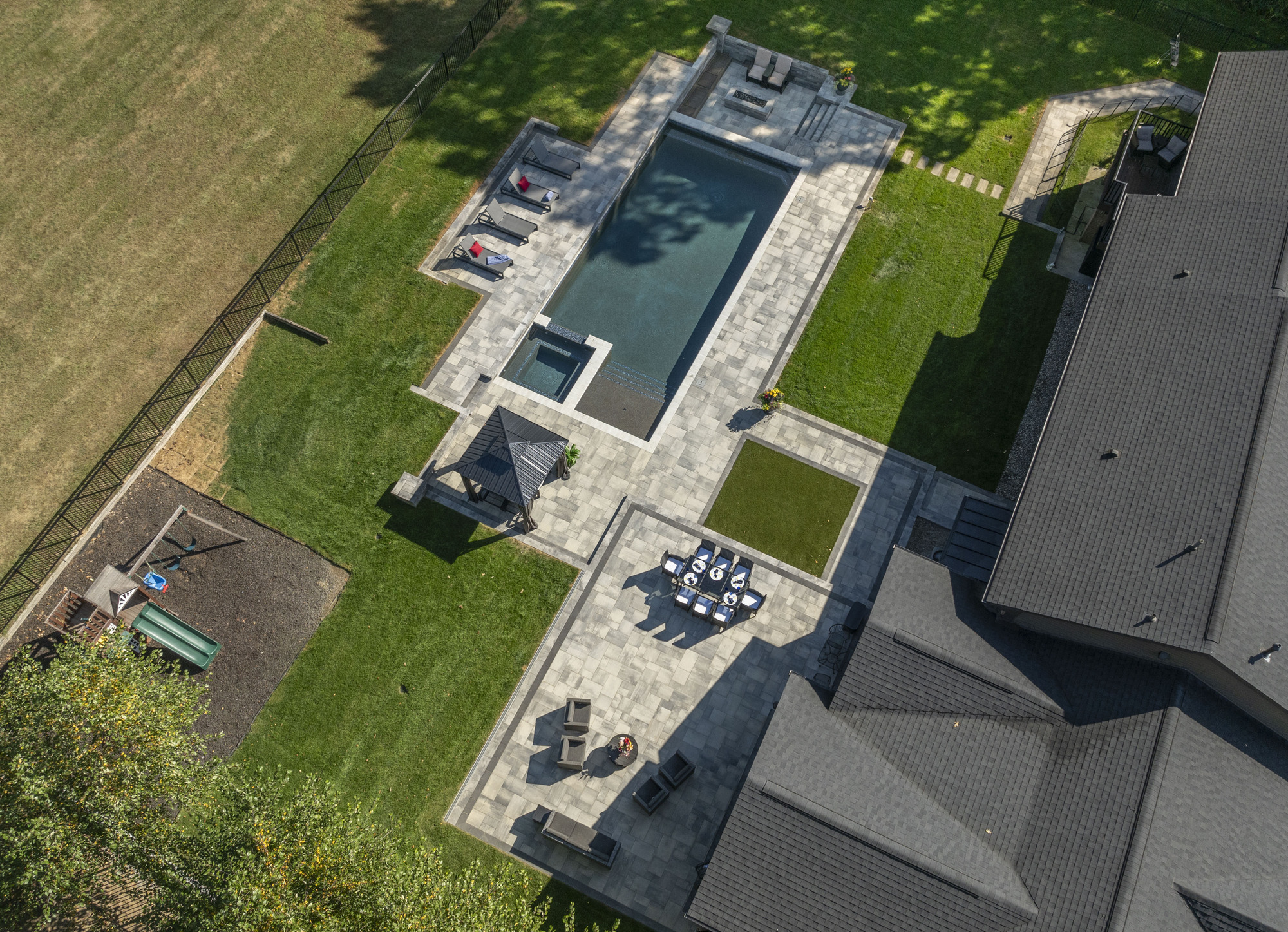
Look at several views of the same project when available. A close photograph can help you discuss materials, while an aerial view reveals the amount of space devoted to seating, paths, and landscape. Neither view is a substitute for a visit or drawings of your own property, but together they make the comparison more concrete. The Tango Pools portfolio is a starting point for discussing those relationships.
Understand what happens between a consultation and construction
Ask each builder to describe the next two or three decisions, not simply the anticipated finish date. Will the next step be a site visit, a concept study, or gathering property records? What will you receive at that stage? Who reviews it with you, and what must be settled before the work moves forward?
A rendering and a construction-ready plan serve different purposes. A rendering may help you evaluate appearance and scale, while other documentation addresses dimensions, materials, elevations, or coordination. Ask what is included in the proposed design stage and which decisions remain outside it. That prevents an attractive early image from being mistaken for a fully resolved scope.
Review Tango Pools’ published design and project process before your conversation, then ask how it would apply to your property. If a desired date matters to you, explain why. Ask which dependencies influence that date and how the schedule will be updated as information becomes available. An initial target should not be treated as a guaranteed completion date.
Compare the whole scope, including the space around the pool
Two proposals with similar pool dimensions can describe very different projects. One may include extensive patio work and restoration; another may assume that work will be handled separately. Before comparing totals, build a simple list of the components you expect in the finished yard.
- Pool and spa: clarify the proposed configuration, finish selections, and equipment assumptions.
- Surrounding surfaces: identify the patio areas, coping, steps, and connections to existing paths that are included.
- Supporting work: ask how utilities, drainage, grade changes, and any necessary walls will be evaluated and assigned.
- Outdoor features: distinguish current work from possible future structures, kitchens, fire features, and planting.
- Restoration: describe the expected condition of access routes, lawn, and disturbed landscape when the agreed work is complete.
Mark each item as included, excluded, an allowance, or unresolved. An allowance needs an explanation of what it covers and how a different selection would be handled. An exclusion needs a clear owner. This exercise is not about making every builder offer the same package; it is about understanding what each package actually delivers.
Test how the team handles a difficult choice
Bring one real tradeoff to the conversation. For example, you might want both a generous lawn and a larger patio, or a prominent spa without interrupting a long swimming area. Ask how the team would help you decide rather than asking it to promise that every preference can fit.
Listen for an explanation of alternatives. What improves with one arrangement, and what becomes less convenient? Which question could be answered by a drawing, and which requires a site check? A builder does not need to agree with every initial idea to be a good fit. What matters is whether you understand the reasoning and feel able to make an informed choice.
Also clarify communication. Ask who your primary contact would be, how questions are documented, and how changes are reviewed before proceeding. If a finish becomes unavailable or a site condition differs from expectations, you should know how options and consequences will be presented. Specific answers here are more useful than a general assurance that communication will be excellent.
Leave the meeting with a defined next step
Immediately after each conversation, write a few notes under the same headings: design fit, relevant project examples, site questions, scope clarity, and communication. Record unanswered questions separately from concerns. A team saying it needs more information is not necessarily a weakness; an unexplained assumption presented as certainty deserves closer attention.
Before moving ahead, request clarification of anything that materially changes your expectations. That could be a design deliverable, the responsibility for surrounding landscape work, or how a future phase would connect to the initial project. You are choosing a working relationship as well as a finished pool, so the way these questions are answered belongs in your decision.
To explore a custom pool and coordinated outdoor setting for your Southeast Michigan home, contact Tango Pools. Bring your priorities, property information, and a few relevant project images. Those starting points can turn a broad builder search into a focused conversation about what belongs on your site and what needs to happen next.